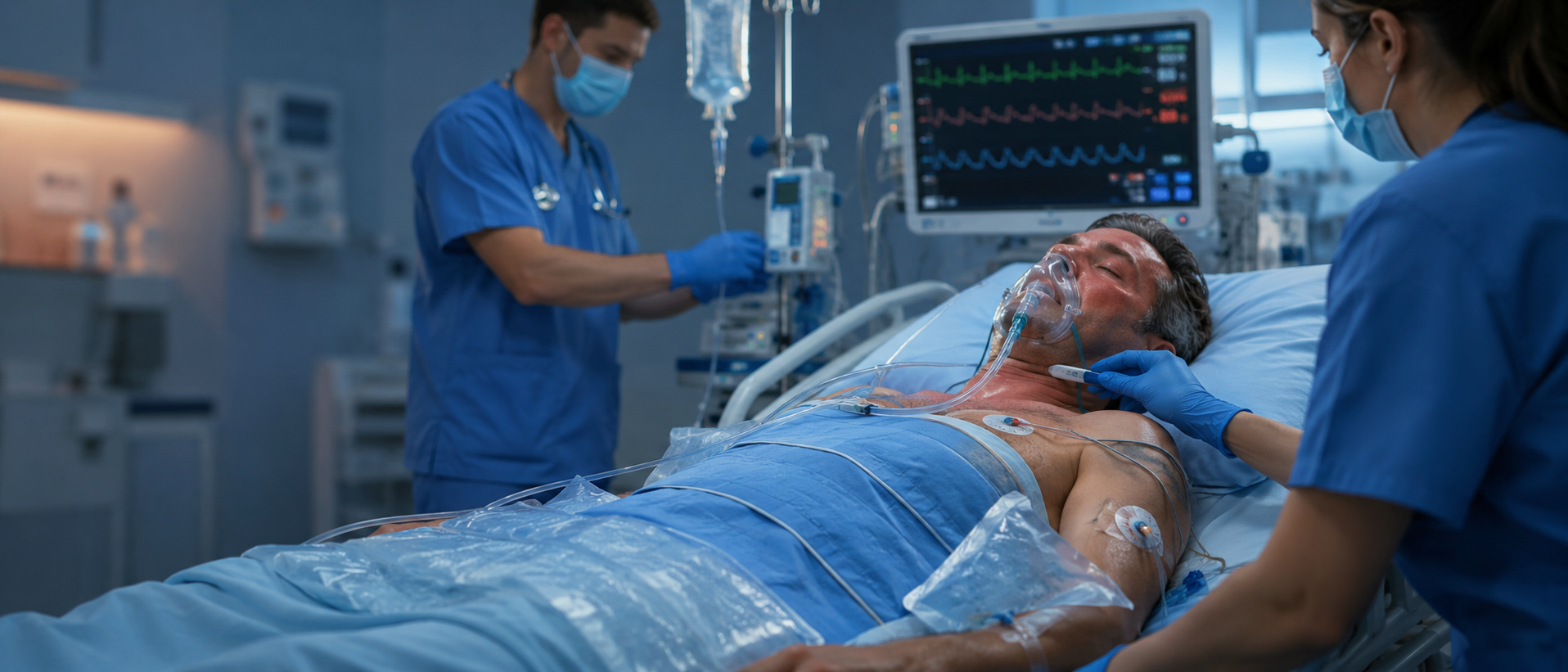
Neurological complications remain one of the most devastating challenges in ECMO care. Despite advances in monitoring technology, detecting acute brain injuries early enough to intervene has remained frustratingly difficult. However, portable MRI technology is changing what’s possible at the bedside, offering ECMO patients access to imaging that was previously difficult or out of reach.
The Silent Threat: Neurological Complications in ECMO
Brain injuries are reported in 7 to 15% of adult ECMO patients and 20% of neonatal ECMO patients.These complications include:
- Intracranial hemorrhage (ICH) – Bleeding within the brain, often related to the systemic anticoagulation required to prevent clotting in the ECMO circuit
- Ischemic stroke – Blockage of blood flow to the brain caused by emboli from the ECMO circuit or thrombus formation, or from inadequate cerebral perfusion during circulatory support
- Hypoxic-ischemic brain injury – Damage from prolonged oxygen deprivation that may occur before ECMO cannulation or during periods of inadequate support
- Seizures – Abnormal electrical activity in the brain that can result from any of the above injuries, often occurring without visible convulsions and detectable only on EEG monitoring
The challenge is that ECMO patients are particularly difficult to assess neurologically. Sedation, paralysis, and critical illness often mask symptoms, while the unstable nature of these patients makes traditional diagnostic approaches difficult or impractical.
Current Neuromonitoring: Valuable but Limited
Today’s standard of care for neuromonitoring in ECMO patients includes continuous EEG to detect seizures and monitor brain function, near-infrared spectroscopy (NIRS) to track cerebral oxygenation, and serial neurological examinations. While these tools provide valuable real-time data about brain function, they share a critical limitation: they cannot directly visualize brain tissue to definitively diagnose structural injuries like hemorrhages or ischemic strokes.
When a neurological complication is suspected based on these monitoring modalities, the next step is neuroimaging. Head CT scans are currently the most accessible option, but transporting a critically ill ECMO patient to the scanner requires a specialized team and carries significant risk—more than 30% of ECMO patients never receive a CT scan during their ECMO run because transport is simply too dangerous. Even when CT is possible, it has limited sensitivity for detecting early ischemic strokes, which are the most common type of brain injury in these patients.
Conventional MRI offers superior imaging—it’s the gold standard for diagnosing acute brain injury—but it operates at magnetic field strengths of 1.5-3 Tesla, making it incompatible with ECMO equipment. The powerful magnetic fields would interfere with ECMO pumps and monitors, potentially causing metal components to heat or malfunction, and moving unstable patients to an MRI suite poses even greater risks than CT transport. For decades, this has meant that ECMO patients have been systematically excluded from the best diagnostic tool available.
A Potential Solution: Ultra-Low-Field Portable MRI
However, recent advances in MRI technology have produced a new solution: ultra-low-field (ULF) portable MRI systems that can be wheeled directly to the patient’s bedside. Unlike their conventional counterparts, these systems operate at just 0.064 Tesla, significantly weaker than standard clinical MRI scanners.
This dramatically reduced magnetic field strength changes everything about safety. Conventional MRI scanners require extensive room shielding and have a large danger zone where the magnetic field could interfere with medical equipment or pull metal objects toward the machine. In contrast, the ultra-low-field scanner’s magnetic field is strong enough to create useful images but weak enough that it only extends about 5 feet from the scanner. Beyond this small safety perimeter, the magnetic field has weakened to safe levels. This means all ECMO equipment, ventilators, IV pumps, and monitors can remain operational just outside this zone, continuing to support the patient throughout the scan.
Perhaps most importantly, the patient never leaves their ICU bed. A team of 4-6 trained staff members uses a lift-and-slide maneuver to position the patient into the scanner, keeping them as flat as possible while the ECMO team monitors circuit function throughout the 30-45 minute scan.
While image quality is lower than conventional MRI, ultra-low-field scans are clinically useful for detecting the most critical brain injuries—hemorrhages and ischemic strokes. For ECMO patients who previously had no access to MRI at all, bedside imaging represents a huge advance in diagnostic capability
The Multicenter SAFE MRI ECMO Study
Research is already emerging about the efficacy and safety of this approach. One landmark multicenter study called the SAFE MRI ECMO Study enrolled 50 consecutive adult ECMO patients at two high-volume centers to assess both the feasibility of bedside portable MRI and the prevalence of brain injuries in this population.
Of these 50 patients, acute brain injury was detected in 22 (44%), with ischemic stroke being most common. In addition, when portable MRI was compared directly with CT scans performed within 24 hours, the MRI detected all 8 ischemic strokes while CT detected only 4—demonstrating superior sensitivity for the most common type of brain injury in these patients.
Importantly, all 50 patients were successfully imaged, with only three minor adverse events occurring throughout the study. This safety profile, combined with the high diagnostic yield, demonstrates that bedside MRI is both feasible and valuable for ECMO patients.
Advancing Neurological Care for ECMO Patients
Ultra-low-field portable MRI represents an exciting advancement in neuromonitoring for ECMO patients. While this technology is not yet universally available, its potential to transform care is clear. It enables definitive diagnosis of stroke at the bedside, eliminates dangerous patient transport, and provides superior sensitivity for ischemic injury compared to CT. When used in combination with continuous EEG, cerebral oximetry, and transcranial Doppler, portable MRI completes a comprehensive neuromonitoring approach that offers both functional and anatomical assessment of brain health during ECMO support.
For ECMO patients facing some of the highest stakes in critical care, every diagnostic advantage matters. Innovations like portable MRI bring us closer to what these patients deserve: timely, accurate diagnosis and the best possible chance at meaningful recovery.