Home base: Wisconsin
ECMO background: Trained in a pediatric CVICU
With our team since: Started PRN in June 2022, transitioned to full-time June 2023
Favorite cases: Complex congenital hearts
ECMO is feast or famine, and that can make staffing enormously difficult. A program might have one ECMO patient in three months, then four in a single week. Programs do their best to plan for every scenario, but no one can predict the future, and it’s challenging to keep enough internal specialists on hand for every spike in volume.
That’s where traveling ECMO specialists come in, giving programs a deep backup bench they can call on whenever the census demands it. So who are these specialists, and how does the model actually work?
Traveling ECMO specialists are nurses and respiratory therapists with deep experience who fly into a hospital, manage ECMO patients for a few shifts, and then fly back out, either home or directly on to a different program in a different state. A handful are assigned to accounts they cover regularly and know well, while others spend their week landing in cities they’ve never been to, walking into ICUs they’ve never seen. As ECMO has grown, so has the demand for clinicians who can show up, ready to work, anywhere in the country.
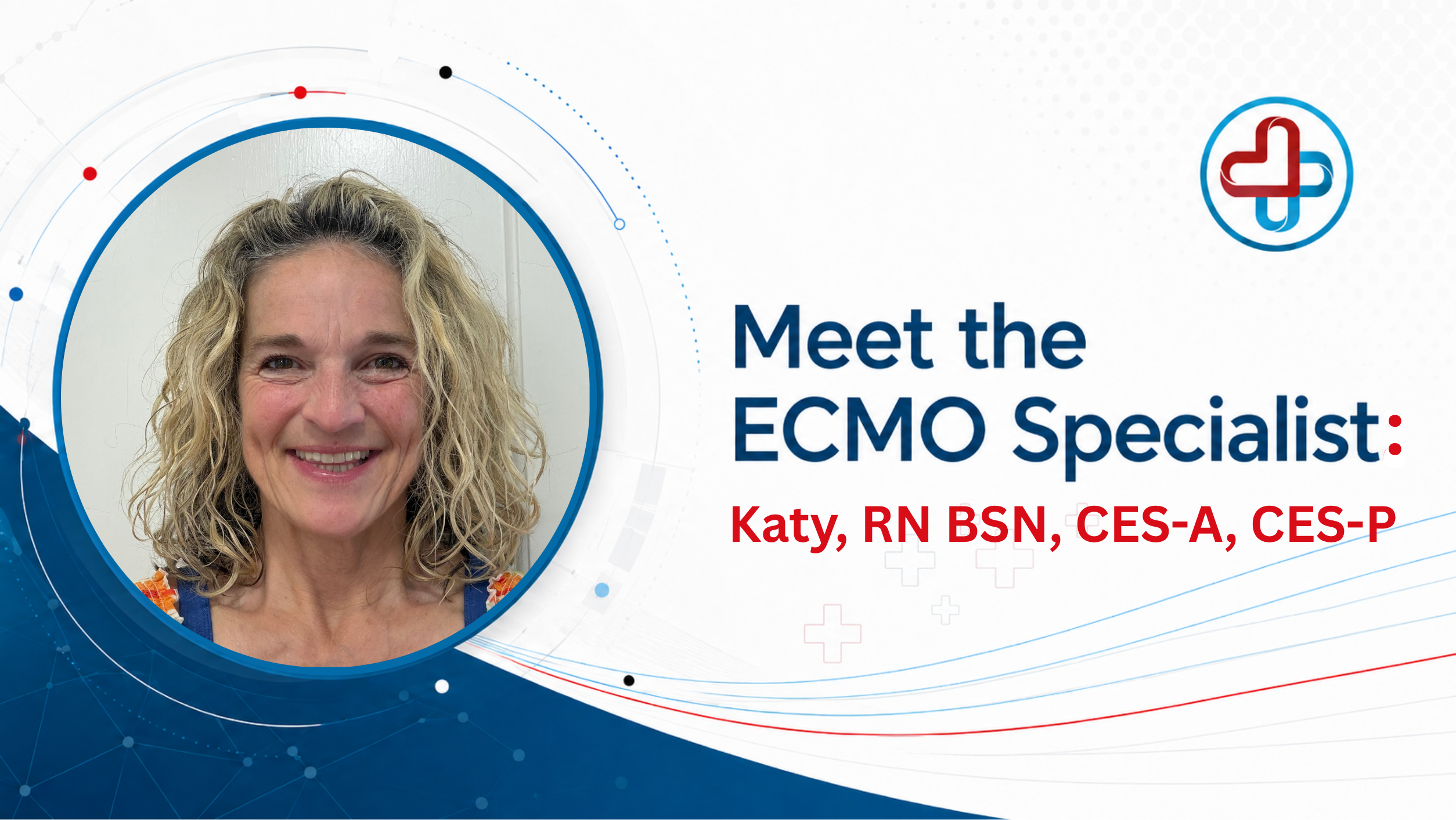
To put names and faces to that work, we’re kicking off a series spotlighting members of our team who are doing the kind of lifesaving work that ECMO makes possible. First up is Katy, a full-time traveling ECMO specialist based in Wisconsin.
How did you end up doing ECMO, and how did you find Integration Health?
Katy first trained in ECMO years ago in a pediatric CVICU. When her kids hit middle school, she stepped away from bedside for a stretch because 12-hour shifts and school-aged kids at home were a difficult combination. She eventually returned to bedside in the emergency department, and that’s where Integration Health found her resume.
By the time she signed on as a PRN specialist in 2022, it had been more than a decade since she’d touched an ECMO circuit. She had never used a centrifugal pump (she’d trained originally on roller pumps, the older technology the field has since largely moved away from), and she had never cared for an adult on ECMO, having spent her early ECMO years in pediatrics.
None of that was a problem. Integration Health ran her through the full training program, then sent her out for extended precepting with experienced specialists at established centers to build her hands-on hours back up. By the time she was sitting cases independently, she had been retrained on the modern equipment and across the full age spectrum, from neonates to adults. “There was all the support in the world for it,” she says.
What does the job actually look like?
Pretty different from a traditional staff job or travel nursing contract. Where a travel nurse typically signs a 13-week assignment in one city, Katy might cover three different programs in a single week. Trips usually run three to seven days, sometimes back-to-back, and assignments can shift on short notice depending on which accounts are busy and where the team is already deployed.
Full-time is considered twelve shifts a month, with additional pay for shifts beyond that. The travel is real, but so is the time off. Katy and her husband have built quarterly vacations into the rhythm of her schedule, with trips to the Smoky Mountains, the Oregon coast, and the Rocky Mountains all happening over the last year.
The hardest part of the job, she says, has more to do with spontaneity than with learning a new hospital; most specialists pick up new units quickly. What takes longer is making peace with the unpredictability. Plans get rearranged, and a weekend off can become a weekend in another time zone. But over time, the unpredictability becomes its own rhythm. You learn when to stay close to your phone, when you can really log off, and how to plan your life around the cadence of the work.
Is there an ECMO case that has stayed with you?
One of Katy’s favorites is a toddler she cared for during a nine-month ECMO run. The patient had been born with tracheal atresia, which led to chronic lung disease, pulmonary hypertension, and eventually right ventricular failure. She cycled through several different cannulation strategies during her time on support. Transplant was considered and ruled out. The team kept supporting her, and against the odds, she began to recover.
By the time Katy was caring for her, she was, as Katy describes it, “a regular three-year-old, except that she was connected to her cannulas.” They played on the floor, built blanket forts, blew bubbles, and watched movies. The little girl was eventually decannulated. Because Katy returns to that program regularly, she has even been able to see her come back for routine follow-ups in the years since.
Cases like this one are why Katy fell in love with ECMO in the first place, and why she still believes in it. The therapy creates outcomes that simply wouldn’t be possible otherwise, and the patients who benefit from it are often the ones with the fewest other options.
What do you love most about the work?
For Katy, a lot of it comes down to the variety. Every hospital does ECMO a little differently. Every team has its own preferences around anticoagulation, cannulation approaches, weaning protocols, and bedside rituals. Specialists who travel see all of it, and they get to carry what they learn from one program into the next.
“You get to learn constantly,” she says. “You’re always learning as a nurse anyway, but you get to learn so much more because you’re taking it from everywhere.”
She also loves the clinical complexity. Complex congenital heart cases are her favorite. There’s always something to figure out, and she gets to figure it out alongside teams who are often the best in their region at what they do.
Four Years on the Road
Katy is one of a growing group of traveling ECMO specialists at IH, each with their own path into this work. What they share is a willingness to keep learning, to show up where the patients are, and to do the kind of intensive bedside work that ECMO requires. After almost four years on the road, Katy’s answer about the job hasn’t changed. “I love it. I can’t think of doing anything else.”
Her story is one part of a larger picture, and we’ll be sharing more of these conversations with our specialists in the coming weeks. Each of them brings something different to the team and to the patients we support.
Interested in becoming a traveling ECMO specialist?
If you’re a nurse or respiratory therapist with ECMO experience and the kind of flexibility this work requires, we’d love to hear from you. IH supports new specialists with the training, precepting, and credentialing they need to ramp up safely, even if it has been a while since they last touched a circuit. See our open roles at https://integration.health/careers-opportunities/.